

How to read this catalogue
There are nine machine families below and 57 models inside them. That is a lot to scan, so it helps to know how the catalogue is organised before you start opening pages.
Every family answers two questions: what surface does it produce, and what form does the material arrive in. A grinding family and a buffing family do different jobs on the same coil. A coil line and a sheet line do the same job on different material. Get those two coordinates right and the model list narrows to three or four candidates.
The four process stages
Surface finishing is sequential. Each stage removes what the previous one left behind, and no stage can fix a problem created earlier in the line.
- Grinding removes the mill finish, rolling marks and light defects, and sets the flatness the later stages depend on. Coarse grit, heavy cut.
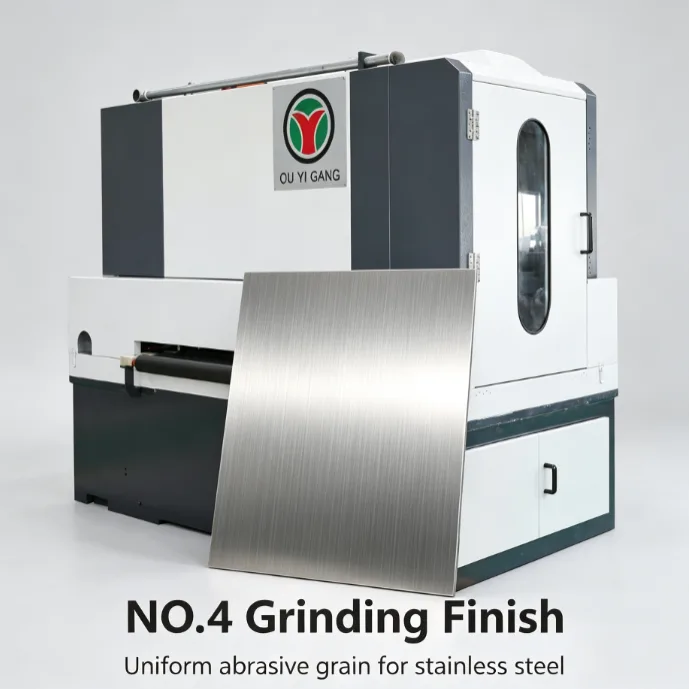
- Polishing refines the scratch pattern left by grinding and establishes the direction and density of the grain. This is where No.4 and hairline diverge.
- Buffing works with compound rather than abrasive belt. It lifts gloss without cutting geometry — the stage that turns a matte surface into something reflective.
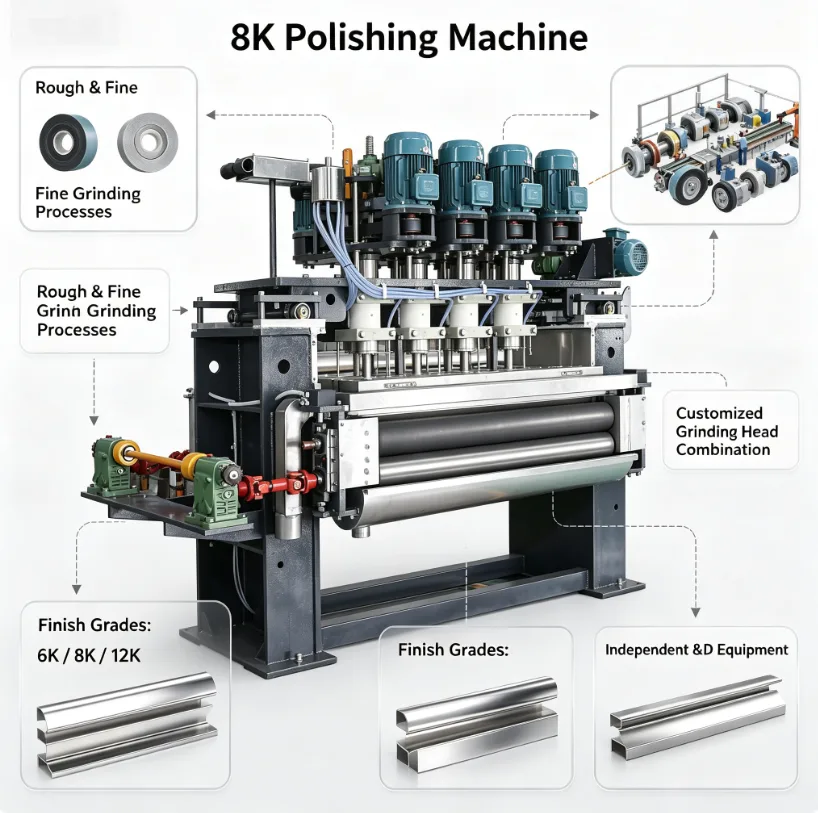
- 8K mirror is a dedicated line, not an extra pass. Mirror finishing needs its own sequence, its own consumables and considerably more floor space than the other three.
Most buyers arrive knowing the finish they want to sell and not the sequence needed to reach it. If you are in that position, the finish library explains what each surface actually is before you look at machines.
Coil or sheet comes first
This decision is made before the model list matters, and it is usually decided by your customer, not by you.
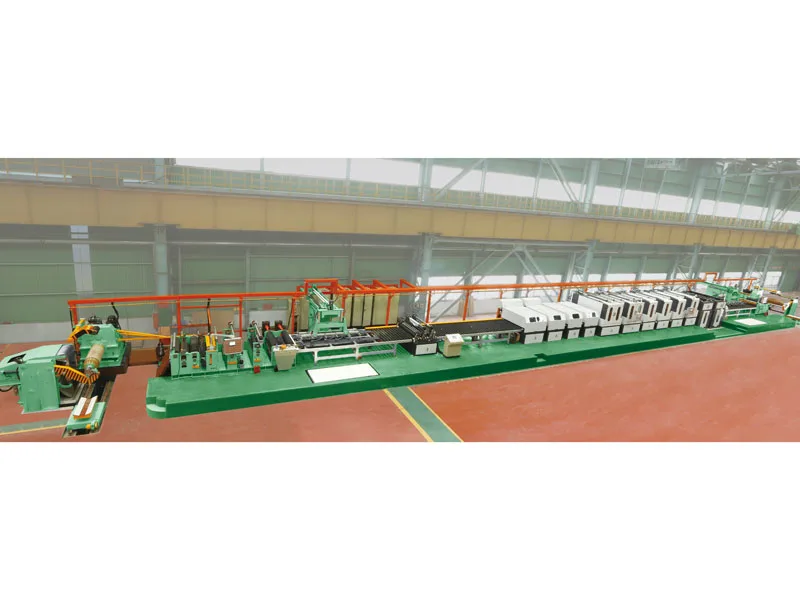
Coil lines run continuously. They suit volume, they suit downstream forming, and they need tension control to be good — a coil with edge wave will finish unevenly no matter how the head is set. Sheet lines take cut-to-length panels and handle mixed orders better, but every panel has an entry and an exit, and that is where edge defects come from.
If you serve appliance or elevator customers who buy finished panels, a sheet line is usually the honest answer. If you supply service centres or roll-formers, it is a coil line. Trying to cover both with one machine is possible and always a compromise.
Three questions that narrow the list
- What width and thickness range do you actually run? Not the maximum the machine can take — the range 80% of your orders fall into. A line specified for the extreme edge of your range will be slow and awkward for the work you do every day.
- What finish number does your customer specify? No.4, hairline, SB and 8K are four different heads, not four settings. If you need two of them, decide whether that is two machines or one line with a changeover — the changeover time is the number that decides it.
- What is your realistic output per shift? Line speed on a spec sheet is a maximum under ideal conditions. Working output is usually 60–70% of it once you account for loading, belt changes and rework.
What buyers usually get wrong
- Buying the fastest line. Speed is the least useful specification. A line that holds its parameters across a shift will out-produce a faster one that needs re-setting every few coils.
- Specifying the machine before the sequence. A polishing head cannot compensate for a grinding stage that was undersized. The bottleneck is almost always upstream.
- Ignoring consumable cost. Abrasive belts, buffing compound and coolant are a running cost that scales with output. A machine that is cheap to buy and expensive to run is not cheap.
- Forgetting what comes after. If the panels go to PVD coating, the Ra target has to be agreed with the coater before the first panel is ground. Getting this wrong is discovered weeks later, at the coating stage, on a full batch.
Not sure which family fits
Describe the material (grade, width, thickness), the finish number your customer specifies, and the output you need per shift. That is enough to narrow nine families down to two, and it is a faster conversation than reading 57 model pages. The application pages show complete line configurations for elevator panels, architectural cladding, kitchen equipment, appliances and food processing equipment — often the quickest way to recognise your own production setup.