
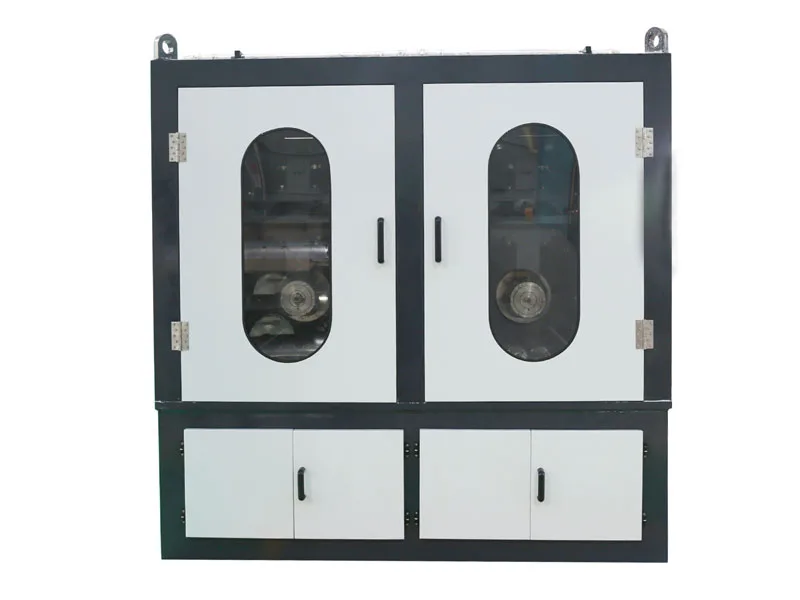
Built for continuous No.4 satin finish production on stainless steel coil, this line takes the coil from uncoiler to recoiler in one pass. Polishing proceeds in defined stages — cut, refine, finish — so the No.4 satin is arrived at rather than forced. The result is the familiar brushed satin surface with grain running consistently along the panel.
How It Works
- Uncoiling — the coil is fed, typically holding 10–15 tonnes.
- Pinch and levelling — strip straightened and aligned so it runs true through the grinding heads.
- Wet roller grinding — wide abrasive belts remove scale and refine the surface, with coolant controlling heat across the continuous run.
- Cleaning and drying — wash and hot-air or air-knife stations remove residue before inspection.
- Recoiling — finished strip rewound under tension control.
On continuous strip, automatic pressure compensation is what keeps the surface consistent at speed — it holds the strip on a fixed path so uneven finish and batch defects do not appear as throughput rises.
Machine Features
- CNC control system — grinding pressure and processing speed adjusted automatically to material hardness, so one recipe covers grades with different hardness
- Automatic pressure compensation — maintains strip position at high line speed, eliminating the uneven polishing and batch defects that come from manual adjustment
- Wet roller grinding — controls heat, extends abrasive life and improves stability on long continuous production
- Tension-controlled coiling — hydraulic coiler holds 10–15 t coils without telescoping
- PLC recipe storage — parameters recalled per grade and finish
- 2 to 3 grinding heads — head count sized to the material removal your No.4 specification requires
Typical Operating Conditions
- System — wet roller grinding
- Sheet size — 1250×2500 mm and 1550×3000 mm, customised available
- Working width — 900 / 1250 / 1500 mm, customised available
- Sheet thickness — 0.3–4.0 mm
- Line speed — 6–25 m/min
- Grinding heads — 2 to 3
- Abrasive belt length — 2620 mm
- Belt abrasive station — No.4
- Roller dimensions — 300 mm OD × width
- Machine weight — approximately 13 T
Common Defects and How to Prevent Them
- Uneven roughness batch to batch — pressure compensation drifting. Calibrate the compensation system and confirm belt tension weekly.
- Longitudinal scratches along the full strip — a damaged roller or contaminated brush. Inspect between orders, not only between different grades.
- Strip wandering off centre — pinch roller alignment or levelling unit out of adjustment.
- Heat discoloration on 316 — check coolant delivery and reduce speed.
- Rust spotting — carbon steel contamination; keep abrasives dedicated to stainless.
Where It Is Used
Cold rolling mills and stainless service centres producing No.4 coil at volume for kitchen equipment, elevators, appliances and architectural use.
Packing & Delivery
Section-by-section testing before shipment, foam edge protection, transparent film wrapping and iron rope securing. Engineers remain responsible for their section through dispatch.
FAQ
How is the No.4 satin kept consistent from batch to batch?
Automatic pressure compensation holds the strip path constant at speed, and stored recipes keep belt pressure, line speed and oscillation fixed per grade. The consistency comes from parameters that are not adjusted between orders.
What grades of stainless steel can this polishing machine handle?
200 and 300 series including 201, 304 and 316, plus 430. CNC adjustment of pressure and speed to hardness means different grades run on the same line.
Can the line also produce hairline or SB?
Yes, by adding refining or brushing stages downstream of the No.4 stage. The number of grinding heads specified determines which finish combinations are possible.
What is involved in installation?
Foundation and service connections, machine positioning, then commissioning with your material. Installation scope is agreed with the order, with training covering operation, parameters and routine maintenance.