
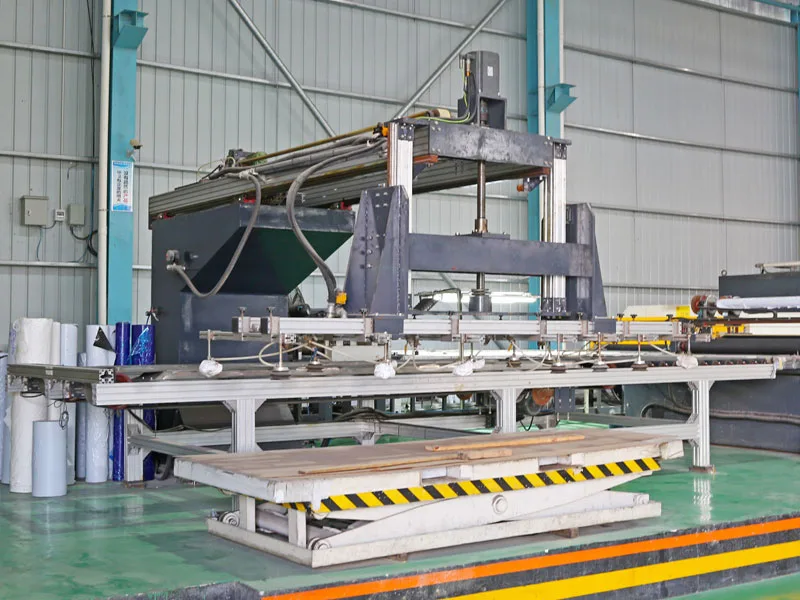
A hairline buffing machine produces the HL finish: long, unbroken, parallel lines with a low-gloss satin sheen. It sits after the grinding stage and is the step that turns a ground surface into the premium architectural and appliance finish specified on elevator doors, facade panels and high-end appliances.
How It Works
For thick-gauge work the line buffing stainless plate to a hairline finish with controlled stock removal. Buffing stations follow the grinding heads, using compound-loaded wheels to bring out the hairline. The value hairline adds is continuity of line — because the grain is unbroken and directional, the surface reads as a single continuous plane under overhead lighting, which is precisely what makes it specified for elevator interiors and facade cladding.
- Grinding stage — fine abrasive belt establishes the direction and evens the grain.
- Buffing stage — bristle wheels with light compound refine the surface to a continuous hairline.
- Cleaning and drying — residue removed and surface dried.
- Optional film lamination — protective film for decorative material.
Key Features
- Continuous directional lines — fine belt and compound wheel combination produces unbroken lines rather than a mottled or cross-hatched surface.
- Adjustable brush pressure and wheel speed — gloss level tuned without changing consumables.
- PLC control with recipe storage — settings held per grade and finish.
- Wet buffing option — keeps compound workable and controls heat.
- Stainless internal frame — resists corrosion in a wet environment.
- Easy brush roll change — consumable swaps do not require dismantling the line.
Brushes and Compound Selection
Hairline depends on pairing the right wheel with the right compound grade — using the same wheel across stages is what produces inconsistent sheen. The sequence is a fine abrasive belt to establish direction, then a bristle wheel loaded with a light compound to refine without cutting. Compound grade is matched to the target gloss: too aggressive and you lose the fine line, too light and the surface never comes up.
Typical Operating Conditions
- Plate thickness — 0.4–4.0 mm
- Plate width — 1250 mm
- Sheet length — up to 6000 mm
- Line speed — 6–20 m/min
- Total power — 150 kW typical
- Grades — 201, 304, 316, 430
Common Defects and How to Prevent Them
- Broken or interrupted lines — the grinding stage is leaving a non-uniform pattern. Fix it upstream; buffing cannot hide it.
- Uneven sheen between panels — compound grade changed mid-batch without reloading the recipe.
- Fine scratches appearing only after buffing — a deep scratch from grinding is being revealed. Correct the grinding stage.
- Compound glazing on the wheel — heat build-up; reduce line speed and check compound delivery.
Where It Is Used
Elevator doors and cab interiors, architectural facade cladding, home appliances, commercial kitchen equipment, bathware and decorative panels — anywhere a continuous fine line is part of the design intent.
Packing & Delivery
Foam edge protection, transparent film wrapping, iron rope securing in container. Each section tested before shipment, with engineers responsible for their section through dispatch.
FAQ
What is involved in installation?
Foundation and service connections, machine positioning, then commissioning with your own material. Installation scope is agreed with the order; training covers operation, parameter setup and routine maintenance.
How is the machine packed and shipped?
Edges covered with soft foam, wrapped in transparent film against dust and steam, then loaded and secured with iron rope inside the container to prevent movement in transit.
What grades of stainless steel can this buffing machine handle?
200 and 300 series including 201, 304 and 316, plus 430. We set the brush and compound profile for your grade when building the line.
Can this machine produce No.4 as well as hairline?
Yes. The finish is determined by grit, compound and which stages are active, not by the machine. Many lines are configured to run No.4 by day and hairline by changing parameters.