
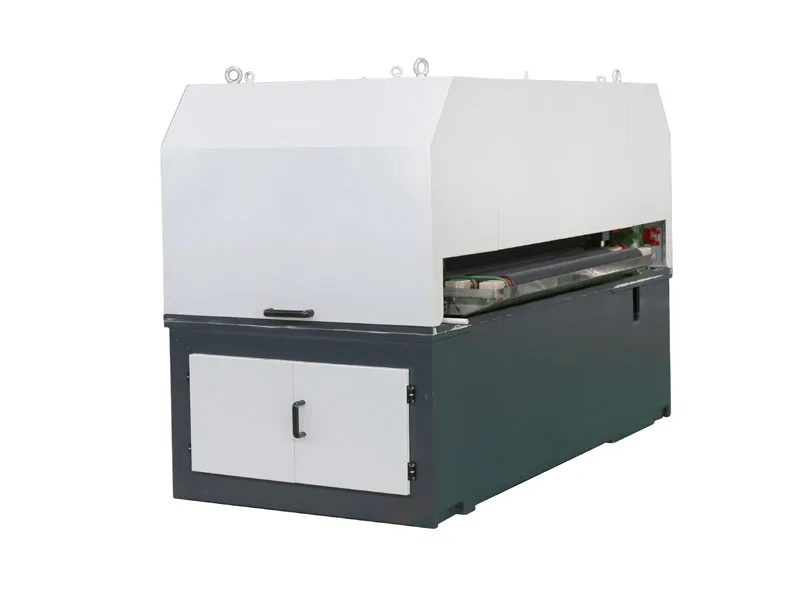
Strip runs through without stopping, which is how the No.4 satin finish stays even from lead end to tail end. Heads are staggered across the width, which spreads the cut and keeps No.4 satin even out to the edges. No.4 satin gives a uniform directional grain that hides handling marks better than a bright finish.
The working section is configured with No.4. The working envelope also covers working width at 900,1250,1500mm, , customized available, so the surface stays within tolerance across the batch.
Machine Overview
This polishing machine is configured for No.4 satin finish on stainless steel coil. Each polishing station is independently loaded, which lets the operator tune the cut and reach No.4 satin on the first pass.
Working width runs to Depending on the sheet width.
This build runs to sheet size 1250X2500mm 1550X3000mm customized available and roller dimensions 300mm, with belt abrasive station No.4 and machine weight Appro 13T.
Features
- Drive is by inverter-controlled motors, letting speed follow the grade being run.
- The bed is ground flat after welding, which is what keeps thin gauge material from marking.
- Oil-type grinding carries the swarf away and keeps the abrasive cool, giving a cleaner surface on long runs.
- Coated abrasive belts give a controlled, repeatable cut and are changed in minutes rather than hours.
Where It Is Used
- architectural wall cladding
- handrails and trim sections
- elevator car panels and lift doors
- exporters shipping processed coil
Packing & Delivery
Export packing for sea freight, 30 days lead time from deposit, and installation supervision with operator training on request.
FAQ
How is the machine packed and shipped?
Export packing: the polishing machine is protected against moisture and mechanical damage, loaded into a container and secured for sea freight. Documentation and the packing list travel with the shipment.
What grades of stainless steel can this polishing machine handle?
The austenitic and ferritic grades used for surface-critical stainless steel coil work run through it — 304, 316, 430, 439 and 445 among others. The abrasive sequence is matched to the grade, so mixed batches can be run without changing hardware.