
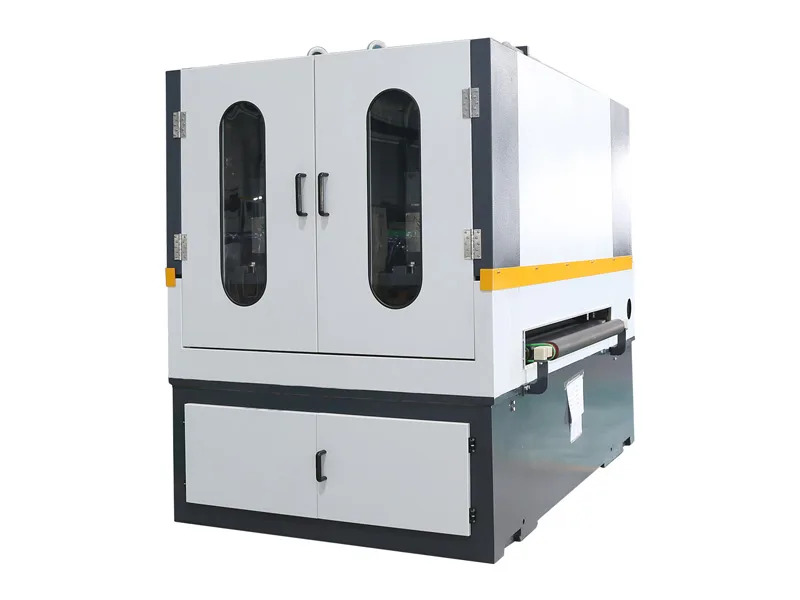
A coil-fed buffing line for stainless steel coil, engineered to hold hairline (HL) finish quality steady from the first metre to the last. Compound application is metered per station, holding a consistent hairline along the full length of the workpiece. HL / hairline is chosen when the architect wants a linear texture that stays consistent panel to panel.
Working coil outer diameter on this machine is 1900. The working envelope also covers speed at 6~60, so the surface stays within tolerance across the batch.
How It Works
This buffing machine is configured for hairline (HL) finish on stainless steel coil. The buffing section is what turns a levelled surface into hairline, cutting haze rather than stock.
Working width runs to 1250.
In the configuration supplied: the total power unit 465; plate thickness 0.4~3.0; uncoil bearing 22; length of production line 37.
Features
- Entry and exit tables are powered, keeping the operator away from the nip points.
- Guide rolls are crowned and adjustable, keeping the strip or sheet tracking true through the machine.
- Guard interlocks are wired to the main isolator, so opening a guard stops the station rather than just alarming.
- Emergency stop and overload protection are wired into every station, not just the main drive.
Where It Is Used
- furniture and cabinet fronts
- column and soffit cladding
- mills running toll processing
- wall panelling in public transport hubs
Packing & Delivery
Standard export packing, container shipment, 30 days from deposit. Commissioning and operator training can be arranged after delivery.
FAQ
Is the machine suitable for thin gauge stainless steel coil?
Within the thickness range listed above, yes. Thin material is supported across its full width through the buffing station, which is what stops it from lifting or marking on the way through.
What grades of stainless steel can this buffing machine handle?
The austenitic and ferritic grades used for surface-critical stainless steel coil work run through it — 304, 316, 430, 439 and 445 among others. The abrasive sequence is matched to the grade, so mixed batches can be run without changing hardware.