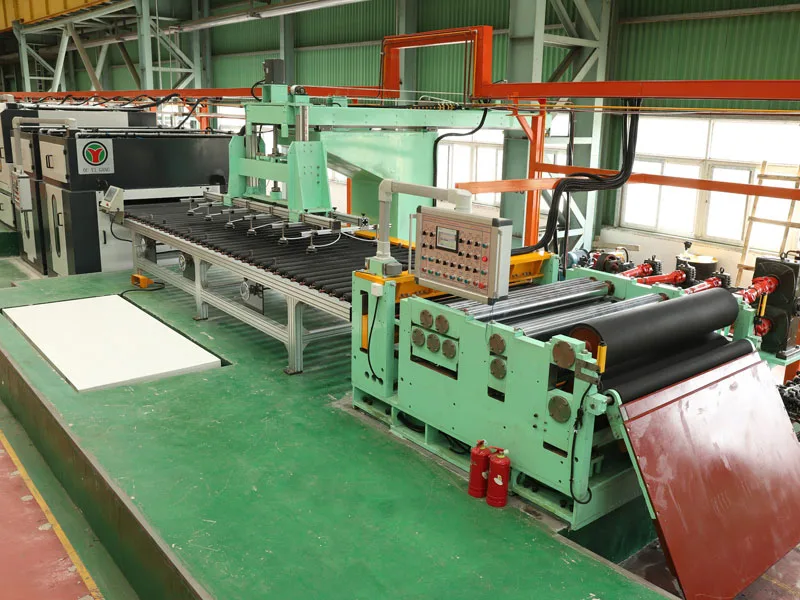
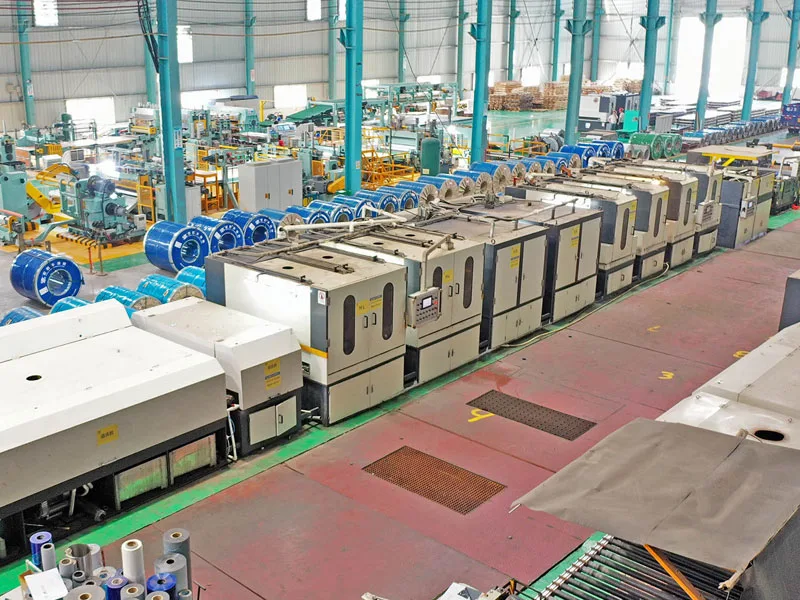
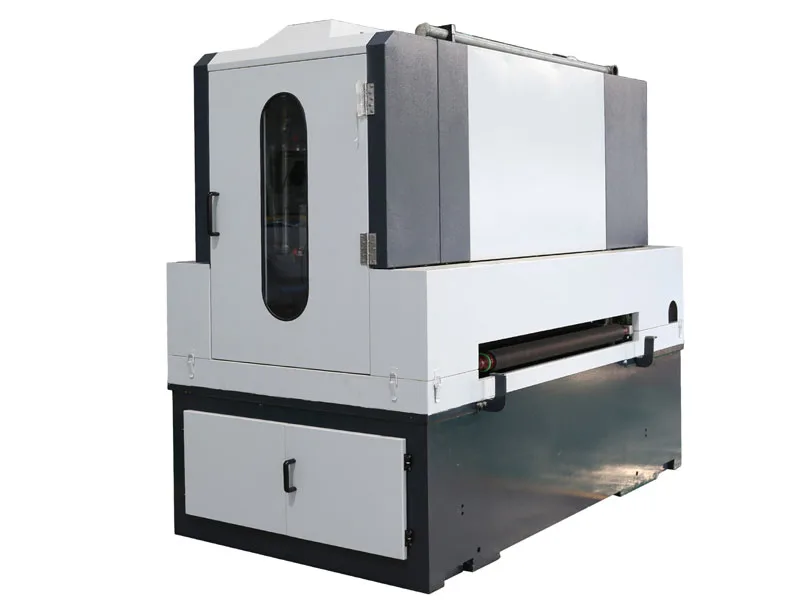
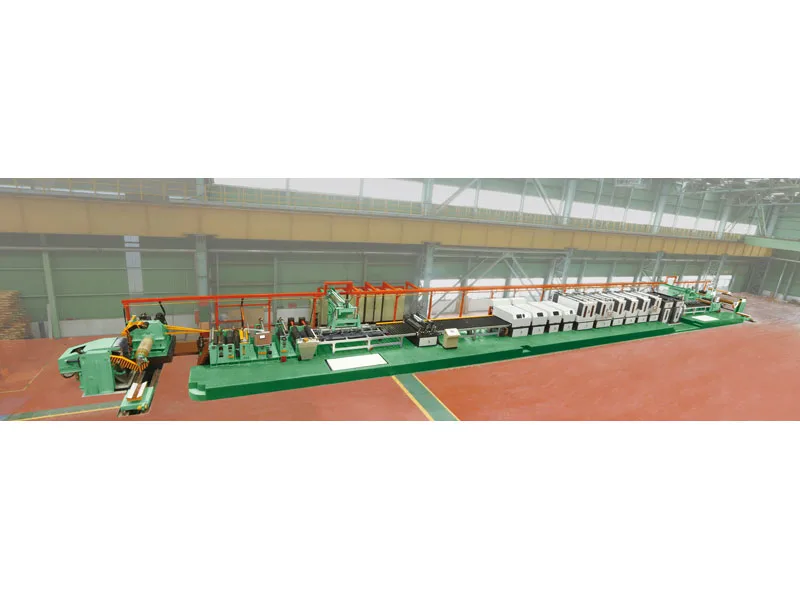
Grinding is the stage that decides whether every later stage succeeds. Its job is unglamorous and non-negotiable: produce a flat, defect-free, uniformly scratch-patterned surface that the polishing stages can refine. A sheet that leaves the grinder with residual mill scale, weld tone or a deep scratch will carry that defect all the way to the finished panel.
What a wide-belt wet grinder removes
- Mill scale and heat tint. The oxide layer from hot rolling. Harder than the base metal and it will tear belts rather than cut cleanly.
- Rolling and handling damage. Dents, deep scratches, coil breaks and edge damage.
- Weld tone. On fabricated blanks, the discolouration either side of a weld seam.
- Incoming inconsistency. Sheet from different mills or different lots rarely arrives in the same condition.
Abrasive sequence: why skipping grades costs more
The grit sequence is a ladder. Each grade exists only to remove the scratch pattern of the one before it. Jumping from a coarse belt straight to a fine one leaves the coarse pattern buried in the surface — invisible until polishing brings up the reflectivity and the scratches appear as a ghost image.
- Cut. Coarse grit, heavy stock removal, establishes flatness.
- Refine. Two or three intermediate grades, each removing the previous pattern completely.
- Finish. The final grit determines what the polishing line receives, and therefore how many polishing stages you need.
The number of stages is not fixed by the machine — it is fixed by the condition of the material you feed it. Tell us what your incoming sheet looks like and we will size the sequence honestly rather than quoting the shortest possible line.
Wet versus dry
Wet grinding is the default for stainless steel, and for three reasons that compound each other. Coolant keeps the workpiece from heat-tinting, which on stainless starts well below the temperature that would matter on carbon steel. It flushes swarf out of the belt instead of letting it load and burn the surface. And it captures the dust, which for stainless is both a health hazard and a contamination source — dry stainless dust settling on finished work causes rust spotting later.
Dry grinding still has a place: small job-shop machines, occasional use, and sites where water treatment is impractical. It is a compromise on belt life and surface consistency, not an equivalent process.
Flatness and edge drop-off
Two defects dominate wide-belt grinding complaints. Longitudinal waviness comes from head pressure that is too high for the sheet thickness — the sheet deflects under the contact roller and springs back past it. Edge drop-off, where the last 30 to 50 mm is ground thinner than the centre, comes from an unsupported sheet edge or a worn contact roller crown. Both are machine setup issues, and both are cheaper to prevent at the specification stage than to chase after installation.