
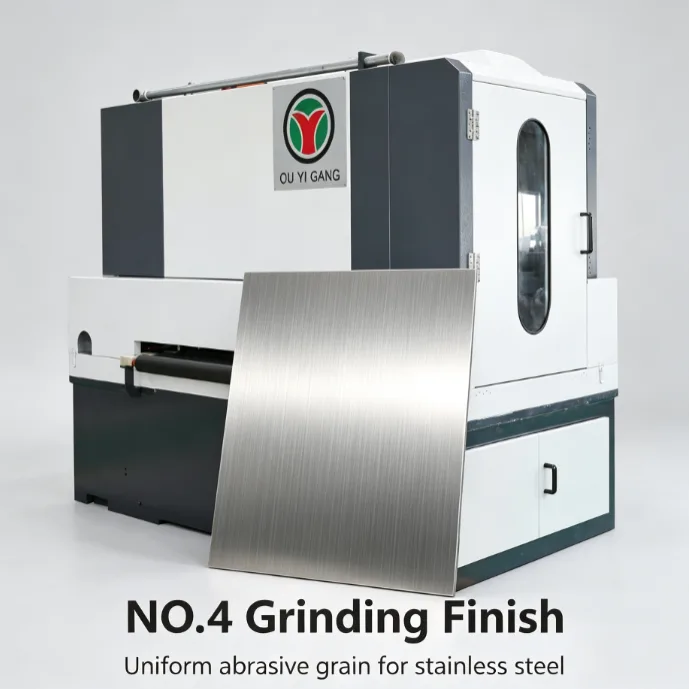
A No.4 grinding machine is the stage that decides whether your finished panels will be uniform. It removes mill scale and roll marks from 2B stainless and establishes the directional grain that No.4 is defined by. This configuration is built for single-sheet work, so a fabricator taking mixed panel sizes to a brushed finish can hold one consistent result across the batch rather than the batch-to-batch drift typical of hand work.
What This Machine Does
The machine takes stainless sheet through a controlled grinding sequence and returns a uniform No.4 satin finish in one pass. It is configured for the finish that architectural cladding, elevator panels and kitchen equipment are specified against — the directional satin surface where the grain runs consistently along the panel and roughness stays stable from panel to panel.
No.4 is the most widely specified decorative finish in stainless steel, and for good reason: it is balanced. It looks refined under interior light, it hides fingerprints better than a mirror, and it wipes clean without smearing. That combination is what makes it the default for elevators, food service equipment and appliance trim.
How It Works
- Material loading — sheet is loaded onto the bed. Configurations handle sheet-to-sheet, coil-to-coil, automatic loading or manual loading depending on the line.
- Wide abrasive belt grinding — the core stage. Wide belts rotate at controlled speed under uniform pressure across the whole surface. Unlike hand polishing, every head runs on fixed parameters, so the grain is identical edge to edge.
- Cleaning and drying — fine particles and abrasive dust are removed before the next stage. A clean surface is required for consistent appearance and for protective film to bond properly.
- Surface inspection — operators evaluate grain direction, surface consistency, gloss uniformity, roughness and visual defects.
- Protective film laminating (optional) — for decorative material, film applied automatically to protect the finish during transport and fabrication.
Key Features
- Uniform grain direction — the precision-controlled wide belt produces a consistent No.4 pattern across the entire surface, so every panel or coil meets the same decorative standard.
- Stable surface roughness — pressure, feed speed and belt performance are controlled to keep roughness consistent across continuous production, reducing batch-to-batch variation.
- Wide abrasive belt technology — uniform material removal across the full working width, rather than a narrow band, which also improves flatness.
- PLC intelligent control — grinding pressure, belt speed and conveyor feed rate managed automatically; processing parameters stored and recalled per material grade and finish.
- Wet grinding technology — cools both belt and workpiece, reducing heat generation, preventing surface discoloration, extending belt life and improving stability on long continuous runs.
Abrasive Selection and Grit Progression
No.4 on this machine is typically produced with an abrasive belt in the 120–180 grit range to establish the directional grain, followed by a refinement pass at roughly 240–320 grit to even the grain before any buffing stage. Belt selection matters more than belt price: a belt that is too aggressive raises material removal and risks waviness, while one that is too fine burns time without cutting.
One rule governs every stage: never progress to a finer grit until the scratch pattern is completely uniform. A single deep scratch left at any stage will emerge as a bright, unpolished scar the moment the buffing wheel passes over it.
Common Defects and How to Prevent Them
- Wavy oscillation stripes across the sheet — the belt oscillation system is out of balance. Check pneumatic pressure and sweep amplitude; the belt should traverse 15–20 mm at 15–25 cycles per minute.
- Rust spots appearing after polishing — carbon steel particles embedded during a previous job. Keep a dedicated set of abrasives for stainless and never run carbon steel on the same belt.
- Heat discoloration on thin material — specify the wet system and reduce contact pressure below 0.5 mm; friction heat on thin sheet causes both tint and distortion.
- Inconsistent finish between batches — parameters are being readjusted job by job instead of recalled from stored recipes.
Applicable Materials
Grades — 201, 304, 316, 430, duplex
Forms — sheet, plate, coil
Thickness — 0.3–3.0 mm standard, heavier on request
Width — 600–1550 mm
Applications
Elevator cabs and door panels, architectural cladding, commercial kitchen equipment, home appliances, metal furniture and precision fabricated components. Any fabricator moving stainless from mill finish to a brushed or satin decorative surface depends on this stage for consistency.
Packing & Delivery
Machine edges are covered with soft foam and wrapped in transparent film to prevent deformation and dust ingress during transit, then secured with iron rope inside the container. Each section of the line is tested individually before shipment, and the responsible engineer stays with that section through to dispatch.
FAQ
How is the No.4 finish kept consistent from batch to batch?
By making the parameters fixed rather than operator-dependent. PLC-stored recipes hold belt pressure, line speed and oscillation constant for a given grade and finish, so the same setup runs whether the operator is experienced or new.
Is the machine suitable for thin gauge stainless steel sheet?
Standard thickness starts at 0.3 mm. Below 0.5 mm, heat becomes the limiting factor rather than the abrasive — specify the wet grinding system and we will reduce pressure and speed accordingly.
What grades of stainless steel can it handle?
200 and 300 series including 201, 304, 316, plus 430 and duplex. Different grades have different hardness and corrosion behaviour, so we tune the belt and pressure profile per grade when we build the line.
What is involved in installation?
Foundation and service connections, machine positioning, then commissioning with your material. Installation scope is agreed with the order, and training covers operation, parameter setup and routine maintenance.