
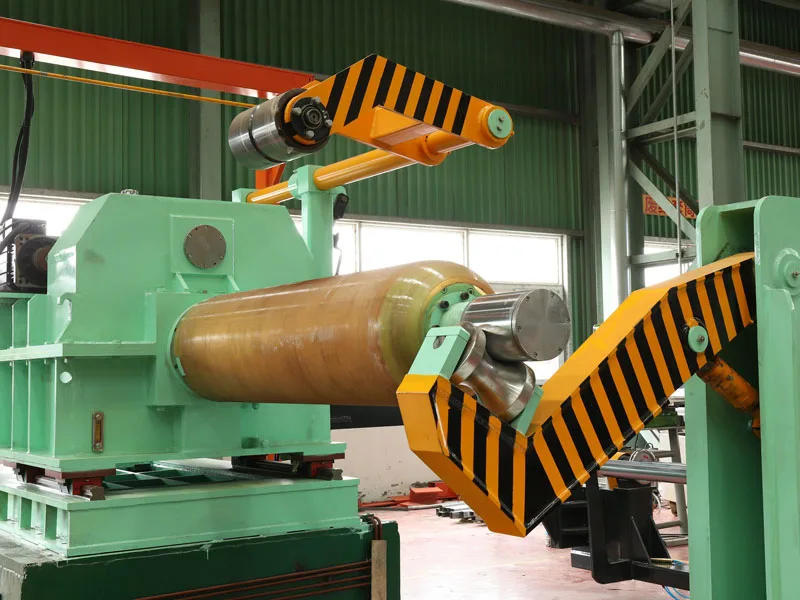
A coil-fed buffing line for stainless steel coil, engineered to hold No.4 satin finish quality steady from the first metre to the last. Cloth wheels and compound do the final work, lifting the surface to No.4 satin after the abrasive stations have levelled it. No.4 is the directional satin finish specified for elevator cabs, kitchen equipment and architectural cladding.
Working width runs to 1250. The working envelope also covers uncoil bearing at 22, so the surface stays within tolerance across the batch.
How It Works
This buffing machine is configured for No.4 satin finish on stainless steel coil. Cloth wheels and compound do the final work, lifting the surface to No.4 satin after the abrasive stations have levelled it.
Line speed is set at 6~60, depending on the finish required.
As specified here — plate thickness 0.4~3.0, coil inner diameter 508 (610), length of production line 37, plate width 1250.
Key Features
- Roll change is done from the operator side, keeping routine maintenance short.
- Abrasive consumption is metered, so running cost per square metre stays predictable.
- Feed and pressure are set from a single panel, so an operator can correct the finish without leaving the station.
- Automatic loading and sequencing mean one operator can run the line, with the cycle repeating without intervention.
Applications
- appliance manufacturers with continuous lines
- architectural wall cladding
- shopfitting and display units
- appliance panels and housings
Packing & Delivery
Standard export packing, container shipment, 30 days from deposit. Commissioning and operator training can be arranged after delivery.
FAQ
How is the No.4 satin kept consistent from batch to batch?
Every station holds its own set pressure and speed, and those values are stored as a recipe. Once a grade and gauge are dialled in for No.4 satin, the next run of the same specification is called up rather than set again by hand.
How is the machine packed and shipped?
Export packing: the buffing machine is protected against moisture and mechanical damage, loaded into a container and secured for sea freight. Documentation and the packing list travel with the shipment.