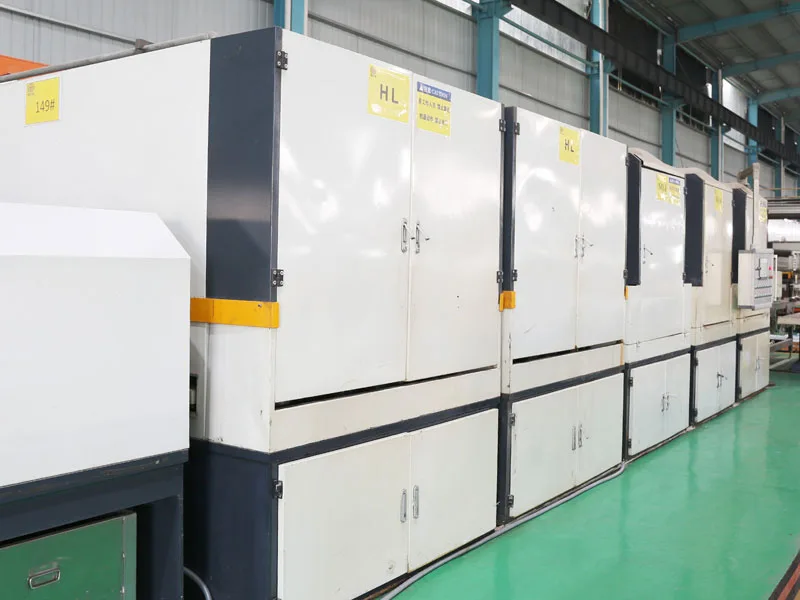
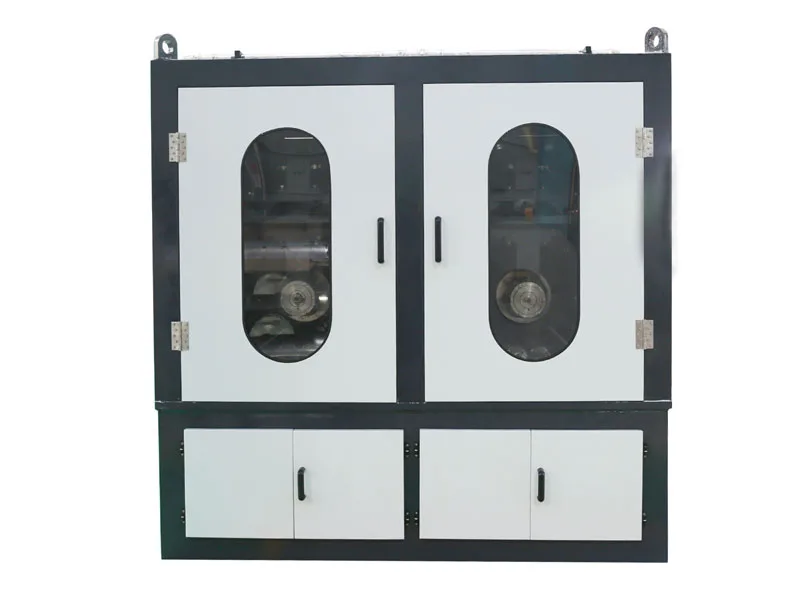
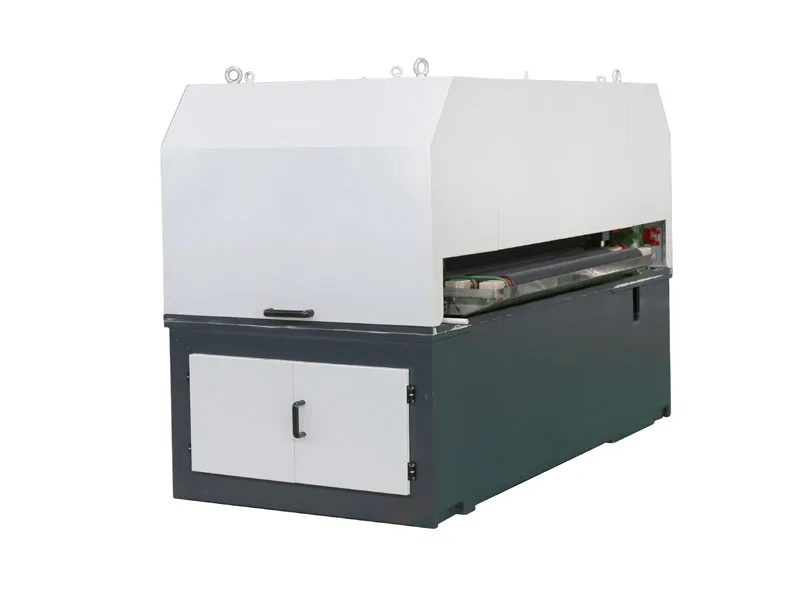
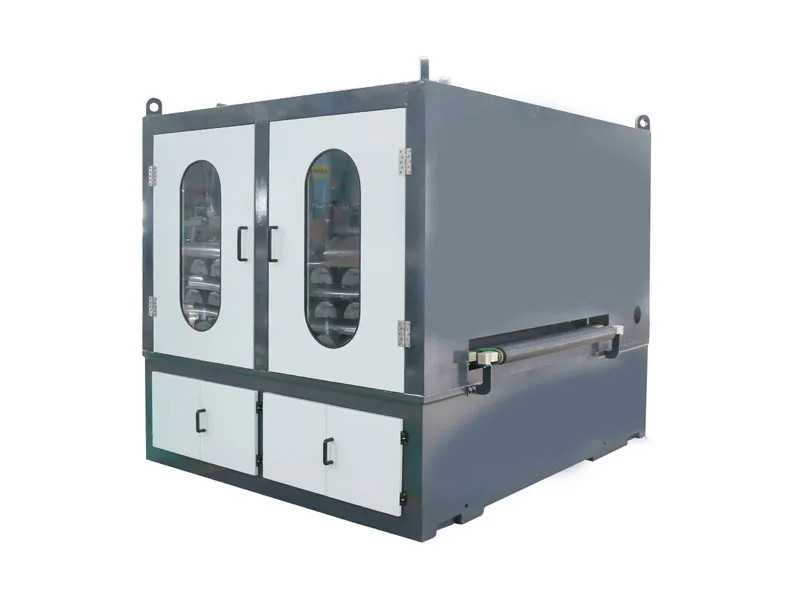
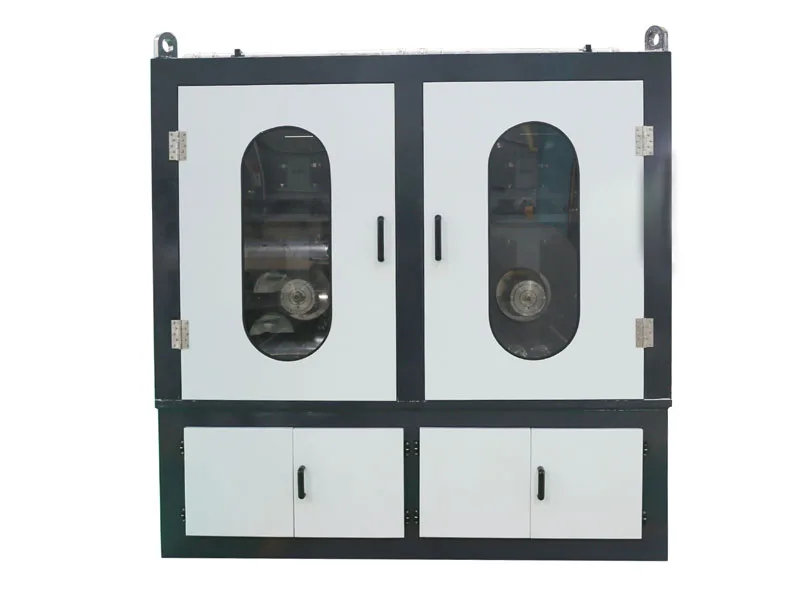
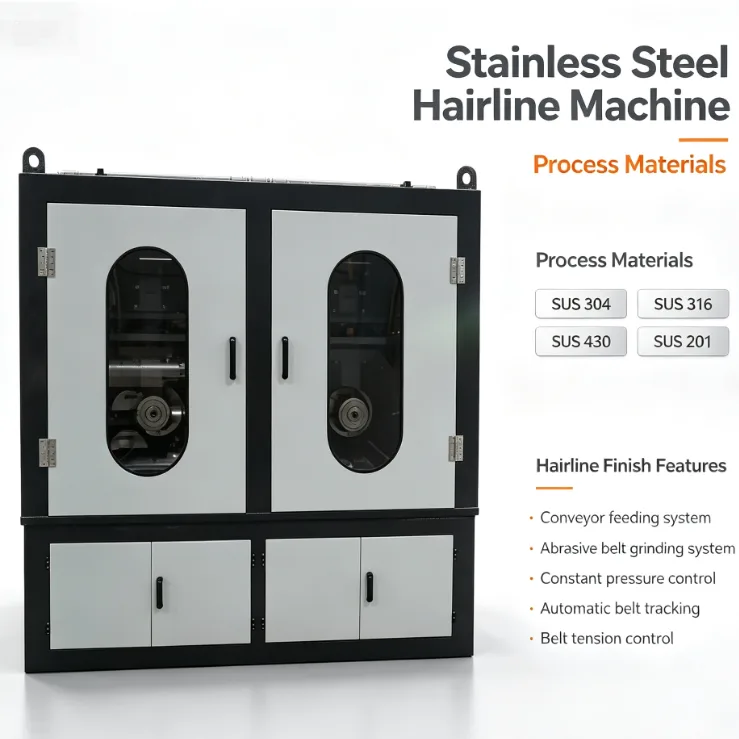
A coil-to-coil line finishes the whole coil continuously: decoil, hold tension, run the strip through a sequence of polishing heads, and recoil. There is no per-piece handling, no stacking and no re-feeding. For volume production of No.4, hairline and vibration finishes this is the reference configuration, and the productivity gap against sheet-by-sheet processing widens with every metre.
Tension is the whole game
The difference between a coil line and a sheet line is not the polishing heads — they are the same principle. It is the tension system. Strip has to be held flat and stable across every head while moving continuously, without stretching it, without letting it wander sideways, and without letting tension spike when the coil diameter changes from full to empty.
- Decoiler and recoiler. Driven, not braked. Load-cell or dancer feedback keeps tension constant as coil diameter changes through the run.
- Tension level. Too low and the strip snakes and the finish varies across the width. Too high and thin gauge stretches, and the strip relaxes afterwards into a wavy panel.
- Strip guidance. Edge sensors correct wander continuously. Without it you lose the coil edges to uneven finish.
Handling coil joints and the coil ends
Real coils contain welds where two lengths were joined at the mill. The line has to pass that joint — thicker, harder and often slightly misaligned — without damaging the heads or marking the strip. Decide this at specification time: automatic joint detection that lifts the heads is standard, and a line without it will eventually cost you a set of contact rollers. The first and last metres of every coil also run at different tension and are normally scrapped rather than sold.
Which finishes suit coil processing
- No.4. The highest-volume coil finish by a wide margin. Forgiving, fast, and the standard supply condition for most architectural and fabrication work.
- Hairline (HL). Achievable on coil, but belt consistency matters more because there is no opportunity to re-run an individual piece.
- Vibration / Scotch-Brite (SB). Well suited to continuous running, provided media life is tracked and media is changed on schedule rather than on appearance.
When coil is the wrong answer
Coil processing is a commitment to volume and consistency. It suits a mill, a service centre or a large fabricator running the same finish day after day. It suits you less if your orders are short, mixed in thickness, or frequently changed — changeover and scrap at the coil ends eat the productivity advantage quickly. If your typical order is a few hundred metres of varying specification, a sheet line will serve you better and cost less.
Specifying one
Beyond width and thickness range, tell us the coil weight and the inner and outer diameters you need to handle, because the decoiler and recoiler are sized from those. Tell us the grades, and the metres per minute you must hold at the target finish. If you are processing material you also slit or cut to length, tell us that too — the line has to sit correctly in the sequence around your existing equipment.