
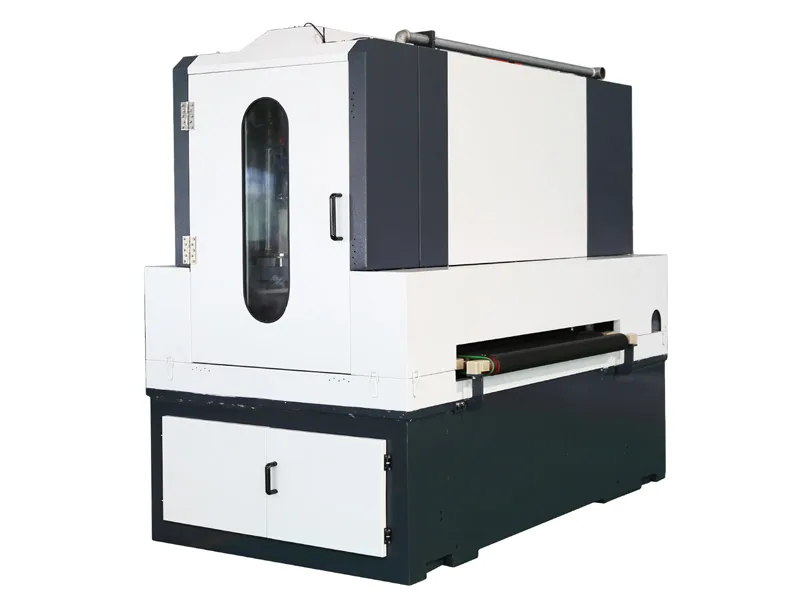
For processors running stainless steel coil in coil form, this line produces a repeatable No.4 satin finish at production speed. The buffing section is what turns a levelled surface into No.4 satin, cutting haze rather than stock. No.4 satin gives a uniform directional grain that hides handling marks better than a bright finish.
It handles work up to 37 long. The working envelope also covers length of production line at 37, so the surface stays within tolerance across the batch.
How It Works
This buffing machine is configured for No.4 satin finish on stainless steel coil. Cloth wheels and compound do the final work, lifting the surface to No.4 satin after the abrasive stations have levelled it.
Rated uncoil bearing: 22.
In the configuration supplied: uncoil bearing 22; length of production line 37; plate thickness 0.4~3.0; plate width 1250.
Key Features
- Coated abrasive belts give a controlled, repeatable cut and are changed in minutes rather than hours.
- Cooling and extraction are built into the station design, holding surface temperature down during long runs.
- Change parts are labelled and stored on the machine, which keeps setup consistent between shifts.
- Oil-type grinding carries the swarf away and keeps the abrasive cool, giving a cleaner surface on long runs.
Where It Is Used
- appliance manufacturers with continuous lines
- architectural wall cladding
- appliance panels and housings
- shopfitting and display units
Packing & Delivery
Export packing for sea freight, 30 days lead time from deposit, and installation supervision with operator training on request.
FAQ
How is the machine packed and shipped?
Export packing: the buffing machine is protected against moisture and mechanical damage, loaded into a container and secured for sea freight. Documentation and the packing list travel with the shipment.
How is the No.4 satin kept consistent from batch to batch?
Every station holds its own set pressure and speed, and those values are stored as a recipe. Once a grade and gauge are dialled in for No.4 satin, the next run of the same specification is called up rather than set again by hand.