
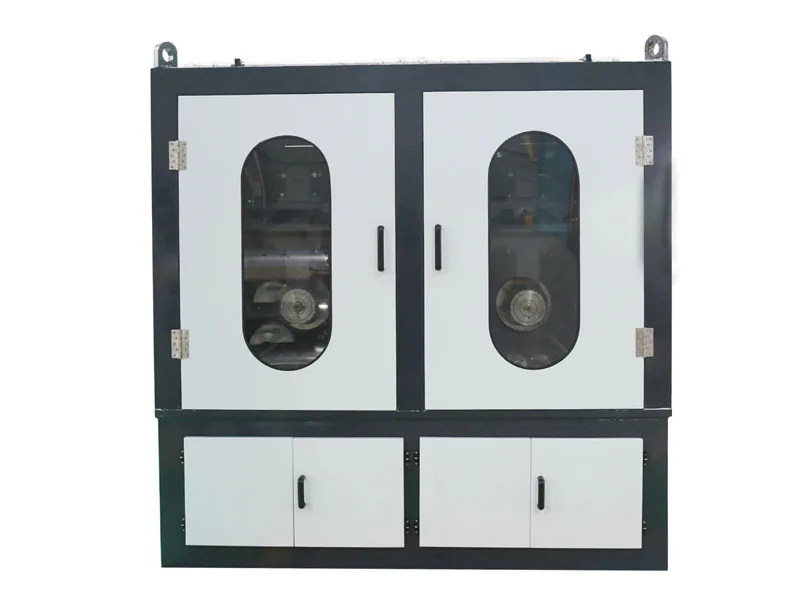
For job shops and panel makers, this polishing machine turns stainless steel sheet into No.4 satin finish panels ready for fabrication. Each polishing station is independently loaded, which lets the operator tune the cut and reach No.4 satin on the first pass. No.4 is the directional satin finish specified for elevator cabs, kitchen equipment and architectural cladding.
The working section is configured with No.4. The working envelope also covers roller dimensions at 300mm, so the surface stays within tolerance across the batch.
What This Machine Does
This polishing machine is configured for No.4 satin finish on stainless steel sheet. The polishing train combines belt and wheel stations, letting one line cover both stock removal and final No.4 satin.
It handles work up to 2620mm long.
In the configuration supplied: no. of working unit 2-3 grinding heads; machine weight Appro 13T; abrasive belt length 2620mm; belt abrasive station No.4.
Machine Features
- Load is spread across the full face of the roll, preventing the ridge that shows as a line in reflected light.
- Change parts are labelled and stored on the machine, which keeps setup consistent between shifts.
- Entry and exit tables are powered, keeping the operator away from the nip points.
- Guard interlocks are wired to the main isolator, so opening a guard stops the station rather than just alarming.
Common Uses
- appliance panels and housings
- hospital and laboratory cabinetry
- subcontract finishers
- handrails and trim sections
Packing & Delivery
Shipped in export packing, secured in container. Lead time is 30 days after deposit; commissioning and training are available on site.
FAQ
How is the No.4 satin kept consistent from batch to batch?
Every station holds its own set pressure and speed, and those values are stored as a recipe. Once a grade and gauge are dialled in for No.4 satin, the next run of the same specification is called up rather than set again by hand.
What sets the throughput of this machine?
Throughput follows the number of working stations, the width being processed and how far the surface has to be taken — reaching No.4 satin takes more passes than a coarse grind. The specification table above gives the working speed for this machine.