
Introduction
Hairline finish stainless steel has become one of the most widely used surface finishes across industries such as architectural decoration, elevators, home appliances, commercial kitchens, food processing equipment, and medical manufacturing.
Compared with mirror finish, a hairline finish offers a softer metallic appearance, minimizes glare, improves scratch resistance, and creates a modern, premium aesthetic. As a result, it is widely applied to stainless steel sheets and coils made from grades such as SUS 304, 316, 430, and 201.
Many manufacturers, however, still ask the same question:
How do you make a high-quality hairline finish on stainless steel?
The answer involves much more than simply sanding a metal surface. Producing a consistent hairline finish requires the right raw material, optimized processing parameters, and, most importantly, a professional stainless steel hairline machine capable of maintaining stable performance throughout production.
Based on our extensive experience in both stainless steel surface finishing and the manufacturing of hairline finishing equipment, this guide explains the complete production process, the equipment involved, key quality control factors, and practical recommendations for manufacturers looking to improve production efficiency and product quality.
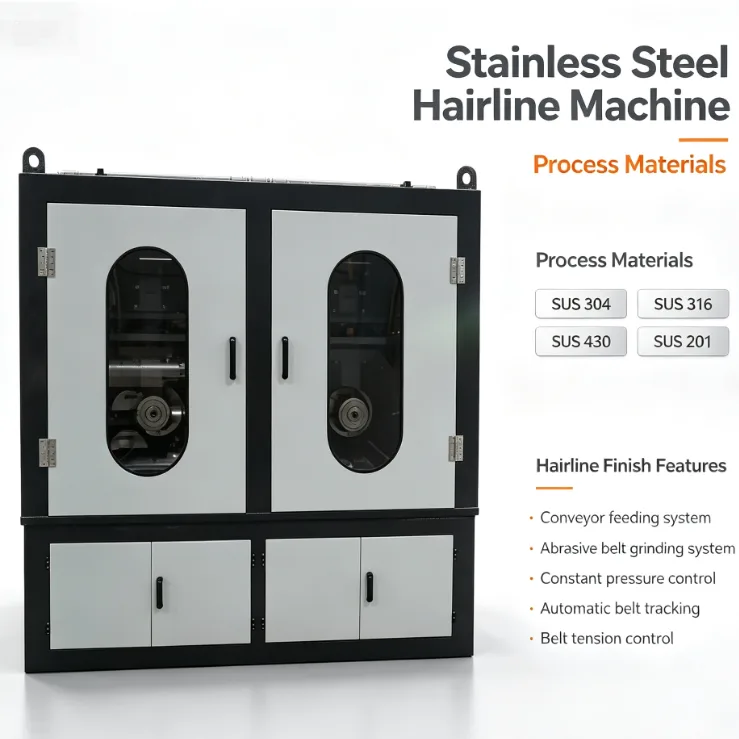
A hairline finish machine is a specialized surface finishing system designed to produce uniform, straight-line textures on stainless steel sheets, coils, and fabricated components. By combining precision abrasive belt grinding, stable pressure control, and an automated conveying system, the machine creates a consistent hairline finish that enhances both the appearance and durability of stainless steel products.
What Is Hairline Finish Stainless Steel?
Hairline finish (HL Finish) is a decorative surface treatment created by continuously grinding stainless steel in one direction to produce fine, straight, and uniform lines.
The finished surface is characterized by:
- Fine and continuous linear texture
- Soft metallic appearance
- Excellent scratch resistance
- Reduced fingerprint visibility
- High-end decorative aesthetics
- Compatibility with PVD coating, anti-fingerprint treatment, and etching processes
Hairline stainless steel is widely used in:
- Architectural decoration
- Elevator panels
- Kitchen equipment
- Household appliances
- Food processing machinery
- Medical equipment
- Commercial interior decoration
For manufacturers, achieving a uniform hairline finish is not only about appearance—it directly affects product quality, brand image, and customer satisfaction.
OUYIGANG Hairline Finish Sample
How to Make Hairline Finish Stainless Steel
Although hairline finishing appears straightforward, producing a consistent surface requires multiple controlled manufacturing stages.
1. Material Inspection
A high-quality hairline finish machine begins with selecting suitable stainless steel.
Common grades include:
- SUS 304
- SUS 316
- SUS 430
- SUS 201
Before processing, manufacturers should inspect:
- Surface flatness
- Original surface condition (2B, BA, No.1, etc.)
- Thickness tolerance
- Surface defects such as scratches, dents, or oxidation
From our production experience, even stainless steel with the same grade may perform differently during grinding depending on the supplier and manufacturing process. Careful material inspection helps reduce defects and ensures stable production.
2. Initial Grinding
The first grinding stage removes:
- Surface imperfections
- Rolling marks
- Minor scratches
Common abrasive belt grits include:
- #120
- #180
- #240
This stage establishes a consistent foundation for the final hairline texture.
3. Hairline Finishing
Hairline finishing is the most critical stage of the entire process.
A professional stainless steel hairline machine combines several systems to produce a consistent linear texture:
- Conveyor feeding system
- Abrasive belt grinding system
- Constant pressure control
- Automatic belt tracking
- Belt tension control
The final finish depends on balancing several parameters:
- Abrasive grit size
- Conveyor speed
- Grinding pressure
- Roller speed
- Cooling performance
Rather than relying on a single setting, successful production requires all of these parameters to work together.
4. Cleaning and Drying
After grinding, the stainless steel surface usually contains:
- Metal dust
- Abrasive particles
- Grinding coolant residue
The material is then cleaned, rinsed, and dried to prepare it for further processing such as PVD coating, protective film application, or packaging.
5. Final Quality Inspection
Finished products should be inspected for:
- Hairline consistency
- Surface brightness
- Uniform grain direction
- Cross scratches
- Bright streaks
- Surface waviness
- Surface roughness (Ra)
Quality inspection is particularly important for export-oriented manufacturers where appearance standards are highly demanding.
How to Choose the Right Stainless Steel Hairline Machine(Hairline Polishing Machine)
When investing in a hairline finishing machine, manufacturers should evaluate more than production capacity.
Important considerations include:
- Compatibility with SUS304, SUS316, SUS430, and other grades
- Ability to process both sheets and coils
- Automatic belt tension and tracking systems
- Easy abrasive belt replacement
- Continuous production capability
- Maintenance convenience
- Future upgrade possibilities
For manufacturers serving premium architectural, food processing, or medical industries, production stability is often more valuable than maximum operating speed.
OUYIGANG Hairline Polishing Machine
Why Practical Manufacturing Experience Matters
Today, more manufacturers are looking beyond machine specifications and evaluating whether equipment suppliers possess real production experience.
A company actively engaged in stainless steel surface finishing understands far more than machine construction. It also understands material behavior, process optimization, production challenges, and quality control under real manufacturing conditions.
With our own stainless steel surface finishing production line, we continuously process various stainless steel grades including SUS304, SUS316, and SUS430 while optimizing equipment design based on actual production feedback.
This combination of manufacturing expertise and equipment development enables us to provide customers with more than just machinery—we deliver practical finishing solutions that help shorten commissioning time, improve production consistency, and increase long-term operational efficiency.
For manufacturers seeking reliable and scalable production, choosing an equipment supplier with real processing experience can significantly reduce technical risks and accelerate project success.
FAQ About Stainless Steel Hairline Machine
What is the difference between Hairline Finish and No.4 Finish?
Hairline Finish features finer, longer, and more continuous linear patterns, making it ideal for premium decorative applications. No.4 Finish has a coarser texture and is commonly used for general industrial and decorative purposes.
Which stainless steel grades can be processed?
Professional hairline finishing machines can process stainless steel grades such as SUS304, SUS316, SUS430, and SUS201 in both sheet and coil formats.
Can Hairline Finish be further processed?
Yes. Hairline stainless steel is commonly used as the base surface for PVD coating, anti-fingerprint treatment, laser engraving, etching, and protective film lamination.
Can one hairline polishing machine process different material thicknesses?
Yes. OUYIGANG stainless steel hairline machines allow operators to adjust conveyor speed, grinding pressure, abrasive belts, and processing parameters to accommodate various material thicknesses and product specifications.